
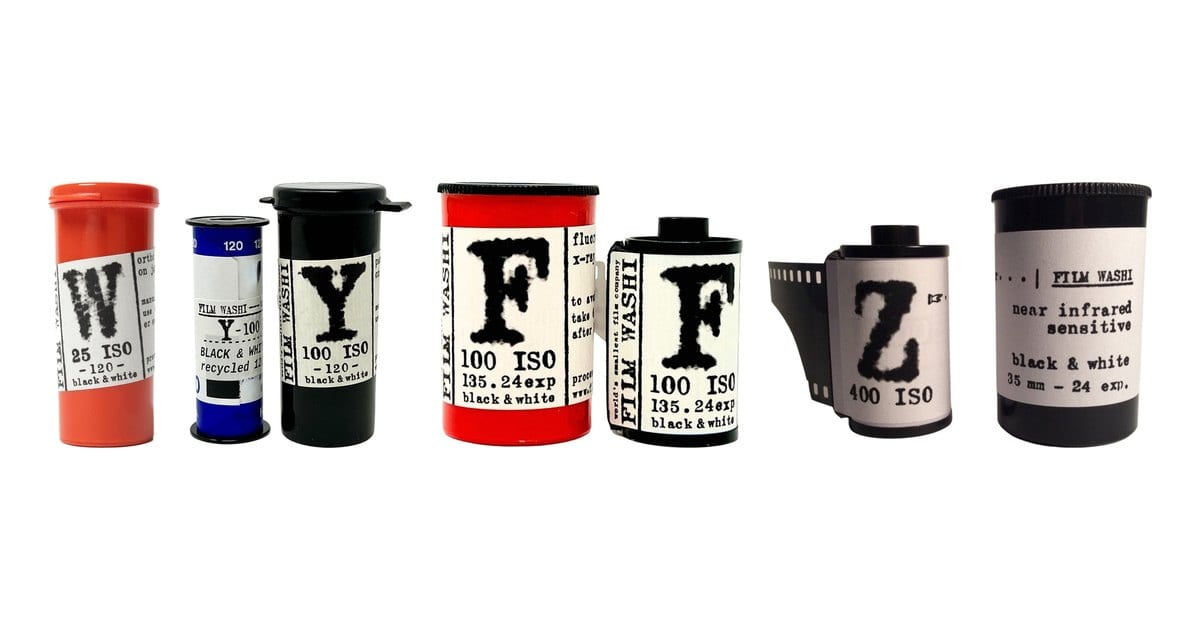
NeoAnalogLab Inc. is now an official retailer for Film Washi, the French film maker. Film Washi’s retailer list shows us under Japan as Neo Analog Lab, Tokyo. We sell its films hand-coated on washi paper, along with its specialty films converted from industrial stock, through our online shop at shop.neoanaloglab.com.
Film Washi sells all of its film through retailers around the world. The only direct sales happen at its booth at the Bièvres International Photo Fair in France, and it works only with dealers that run their own physical or online shop (Film Washi FAQ). Photographers in Japan now have one more authorized place to buy it.
The World’s Smallest Film Company, Run by One Person
Lomig Perrotin founded Film Washi in 2013. He started in a closet in his Paris flat, moved to the family garage in Saint-Nazaire, and now works out of decommissioned French Army containers in Brittany. The business has grown, but it is still one person: Perrotin makes everything himself, and the company calls itself the world’s smallest film company. About Film Washi
Many of his production tools are built from recycled parts, including the 120 rollers, the 135 cassette loader, and the infrared goggles he wears to work in the dark. 135 film goes into recycled cassettes, and 120 film is rolled with reused backing paper. Film Washi has sold more than 170,000 films since it started. Even so, it does not try to compete with the major film makers. It aims to complement them, offering photographers a different way into analog photography.
- Company: FILM WASHI EURL
- Location: Brittany, France (Josselin)
- Founded / Founder: 2013 / Lomig Perrotin
- Business: Hand-coated films and photographic paper, conversion of industrial films into photographic formats, custom work
- Website: filmwashi.com
Hand-Coated on Washi, One Roll at a Time
Film Washi began with W, a black-and-white film hand-coated on traditional Japanese washi paper. The base is Moriki Paper’s Tosa washi, made from kozo fiber at 28 g/m². The paper fibers show up in the negative, so the film base itself becomes part of the picture.
The idea draws on Henry Fox Talbot’s calotype paper negatives of 1841 and Eastman’s early paper roll film of around 1884. The aim is a strong graphic effect that recalls early twentieth-century pictorialism, produced directly on the negative. Because every roll is coated by hand, each one carries small variations and accidents. Film Washi treats them as part of the look.
Y came later: the same kozo paper coated with an ISO 100 panchromatic emulsion. Film Washi calls it W 2.0. It is easier to expose and suits a much wider range of subjects. In 2025 the company also introduced B, a black-and-white photographic paper coated on 110 g/m² bamboo paper handmade in Japan by Awagami Factory in Tokushima.
Paper made in Japan becomes film and photographic paper in a French workshop, then comes back to Japan. We are glad to help bring it to photographers here.
Technical Films, Converted for Cameras
The other half of the range is what Film Washi calls specialty films. These are films coated in other factories for technical work, such as medical and industrial X-ray, aerial survey, and printed circuit board production. Film Washi cuts and converts them into 135, 120 and sheet film so they can be used in ordinary cameras. Specialty films
None of them was made for photography, so they behave differently from ordinary film. Some have no anti-halation layer, and one is blind to green light. Those properties show directly in the images.
What We Carry
Washi paper films (hand-coated)
- W (ISO 25; 120, 4x5): Orthochromatic film on kozo washi, with a strong paper texture and high contrast.
- Y (ISO 100; 120): Panchromatic film on the same kozo washi. An improved W with softer contrast that can be pushed or pulled two stops.
Specialty films
- F (ISO 100; 135, 120, 135 bulk 30.5 m): Medical X-ray film used for mass lung screening. It has no anti-halation layer, so highlights glow.
- Z (ISO 400; 135, 135 bulk 30.5 m, single-use camera): Near-infrared aerial survey film. It separates vegetation well, and a red filter strengthens the infrared effect.
- K (ISO 100; 120, 4x5): Kodak Plus-X Aerographic 2402 that expired in 2000. Fine grain, with the original perforations showing in the frame.
- E (ISO 3; 120, 4x5): Film made for printed circuit board production. It is blind to green and develops like photographic paper.
- X (ISO 100; 135): Color film with no orange mask. Warm, saturated color, developed in either C-41 or E-6.
Paper and accessories
- B (8.9 × 12.7 cm, 12.7 × 17.8 cm; grade 3): Black-and-white photographic paper coated on Awagami Factory bamboo paper.
- 120 processing leader: A blank leader with no emulsion that lets you develop the paper-based W and Y on standard reels.
Each product name links to its page in our shop, where you can check current stock. The film pages also include sample photos.
Before You Buy and Shoot
Film Washi films don’t always behave like regular store-bought film. These are the main points from Film Washi’s data sheets and FAQ.
- 135 comes in recycled cassettes: There is no DX code, and Film Washi advises against fully automatic or motorized cameras. Use a camera with manual film advance and set the ISO by hand.
- Load in the shade: Load F (135) and Z in the shade, then shoot six blank frames with F, or three with Z, before your first picture. For Z, the data sheet gives the reason: its clear base can pipe light into the roll (light piping).
- 120 is hand-rolled: A few delicate cameras may struggle with it. Never force the winding lever, and secure the exposed roll with a rubber band or tape.
- W and Y have a paper base: They are too thin and flexible for modern reels on their own. Load them together with the processing leader, or develop W in trays with paper developer under a safelight. Use cold water instead of an acid stop bath, fix for at least 10 to 12 minutes, and wash for at least 25 minutes, changing the water every 5 minutes. The film curls hard as it dries; roll it back up and leave it for about 12 hours to flatten.
- Safelights: W and F can be handled under a red safelight. Y, Z and K need total darkness. E is sensitive to red, so use a green (500 nm) safelight or work in total darkness.
- Development times: Each data sheet lists times by developer. For developers not listed, use the times and dilutions for Ilford FP4 with F and Y, and for Ilford Delta 400 with Z.
- Lab processing: Film Washi does not offer processing. Most of its films can go to any lab, but for films that need special handling, such as W and Y, it recommends developing them yourself or checking with your lab first. If you would like us to develop them through our film development service, please contact us before sending film.
If you suspect a product defect, please contact us. Film Washi replaces any film with a confirmed manufacturing defect.
For questions about the range or how to use it, reach us through the contact form.