
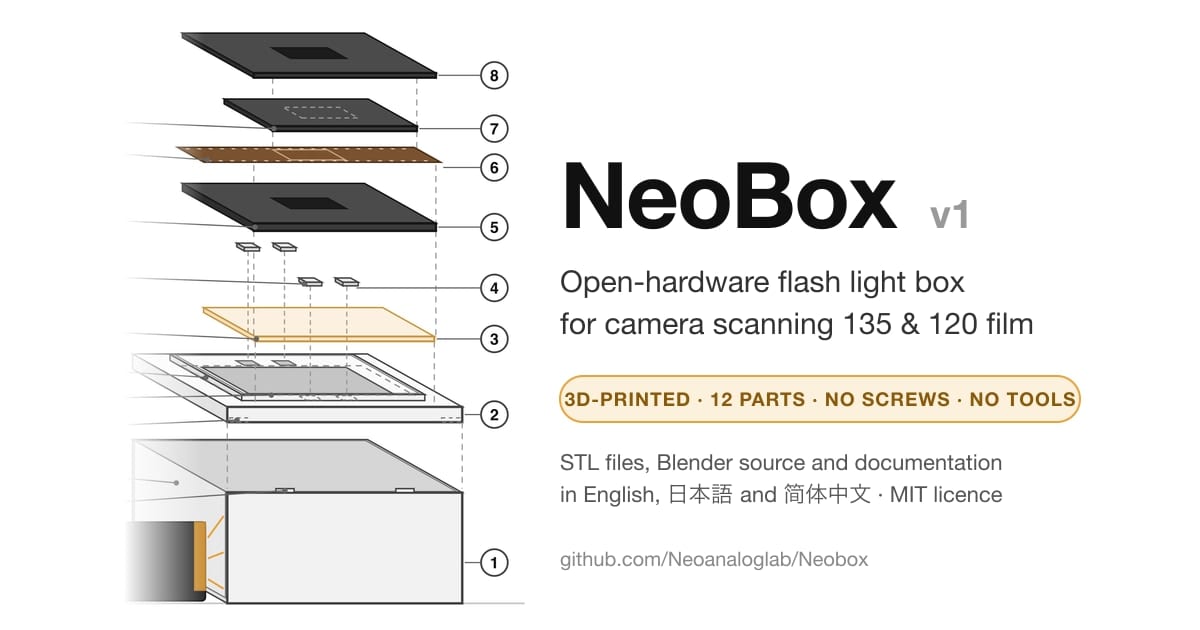
NeoAnalogLab Inc. has completed development of NeoBox, a flash light box for camera scanning 135 and 120 film, and released it on GitHub as open hardware that anyone can 3D print. The repository holds twelve STL files, the Blender source, the drawings and a full documentation set in English, Japanese and Simplified Chinese, all under the MIT licence.
What NeoBox Is
NeoBox is a white box with a fully open front. A single hot-shoe speedlight lies flat on the desk with its head at the opening and fires into the box. The light bounces around the white cavity several times and passes through one opal acrylic diffuser, which becomes an evenly glowing surface under the film. A film holder sits on top, and a digital camera with a macro lens photographs the film from directly above. That technique, camera scanning, replaces a film scanner with a camera, and NeoBox is its light source.
The box measures about 125 × 155 × 83 mm, uses twelve printed parts (four of them optional) weighing roughly 300–350 g, and assembles with magnets and gravity alone: no screws, no threads, no glue, no tools. The longest part is 154.8 mm, so a 160 × 160 mm build plate prints the whole set, and every part prints support-free.
- Formats: 135 and 120 up to 6×9. 6×6 via a mask insert, mounted 135 slides via the optional slide plate, and 4×5 sheets via the optional 4×5 stage.
- Printed parts: twelve STL files, three in white and nine in black, about 300–350 g of PLA.
- Bought parts: one opal acrylic diffuser (68 × 118 × 2 mm), 32 Ø8 × 2 mm magnets and four steel washers. Optionally, one anti-Newton glass and a flocking sheet.
- Light source: any hot-shoe flash with manual power control.
- Licence: MIT.
Why a Flash, Not an LED
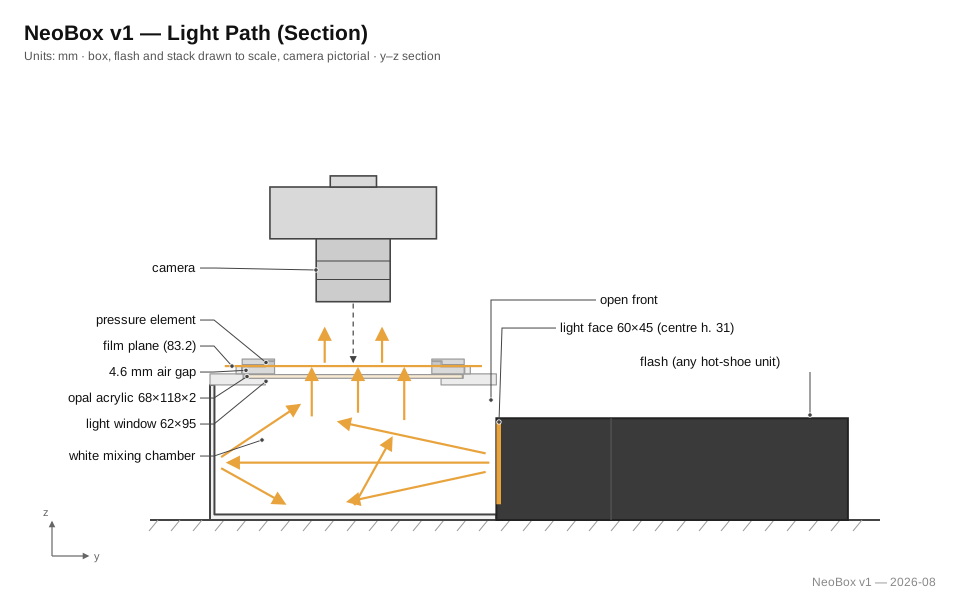
NeoBox uses a flash rather than a continuous LED panel, for three reasons.
- Vibration stops mattering. The flash pulse is the exposure. At working power it lasts 1/1,000 to 1/20,000 s, while the camera’s shutter simply stays at an ordinary sync speed such as 1/125 s. That is one to three orders of magnitude shorter than the 1/15 to 1/60 s of real shutter time a continuous LED needs at base ISO and f/8, so copy-stand flex, shutter shock and footsteps on the floor make no visible difference.
- A spectrum film was made for. A xenon tube emits a continuous spectrum at roughly 5600 K with daylight-class colour rendering (CRI typically 95 or above) and strong deep red, which LEDs struggle with. The cyan layer and the orange mask of colour negative film both work at the red end of the spectrum, so the dip near 480 nm and the roll-off past about 630 nm in a typical white LED show up after inversion as colour casts that will not grade out.
- The same light for the whole roll. A manual flash at a fixed power repeats shot after shot, so one inversion profile fits a whole roll. There is no warm-up drift and no PWM dimming to band against an electronic shutter.
There is a commercial precedent for this recipe. Ricoh’s PENTAX FILM DUPLICATOR pairs a digital camera and macro lens with an external strobe fired through a diffusion screen. NeoBox puts the same optical recipe into a box you can print at home.
What Is in the Repository
- Twelve STL files: three white parts (the main body, the cover-stage and a 4×5 cover-stage) and nine black parts (four film-holder parts for 135 and 120, two pressure-window inserts, the 6×6 mask, the 135 slide plate and the 4×5 sheet plate).
- The Blender source:
cad/neobox.blend, the authoritative geometry, plus the committed STL exporter and a verification script that checks watertightness and every dimension. - Eighteen drawings: optical path, cross-section, exploded view, print orientation, capture setup and a manufacturing overview, each in English, Japanese and Simplified Chinese.
- Ten documents: getting started, bill of materials and sourcing, 3D printing, assembly, scanning, troubleshooting, a glossary, design and a design log in three languages, plus contributing guidelines in English, including copy-paste vendor scripts for ordering every part.
Everything is released under the MIT licence: build it, modify it, sell what you build. No permission needed.
What You Need to Own
NeoBox is one half of a scanning rig. It replaces the light table, not the camera above it. To build and use one, you will also need:
- A digital camera with manual exposure and raw capture (mirrorless or DSLR).
- A macro lens capable of 1:1. One lens covers every format in this project.
- A copy stand, or a tripod with a horizontal or reversible column, to hold the camera square above the box.
- A hot-shoe flash with manual power control and a radio trigger set (the reference build uses a NEEWER TT560 with a ZENIKO T1 set).
- A remote release and software to invert the negatives. Our free Mac app Negative Converter can handle the inversion.
Where the Project Stands
This is the first release of the v1 geometry. Here is what has been verified and what has not.
- Verified in software: all twelve STL files are watertight single solids, every horizontal face sits on the 0.2 mm layer grid in its print orientation, and every bounding box matches the published dimensions.
- Verified in plastic: we have printed this geometry and have been scanning 135 and 120 film with it. Friends of the designer have run it with their own flashes and film. The 6×6 mask, the slide plate and the 4×5 stage have been printed and used as well.
- Not yet measured: the evenness and film-flatness figures in the documents are design targets derived from the CAD, not instrument measurements. The box scans evenly by eye and in the inversions, but no flat-field numbers have been written up yet.
If you build one, we would like to hear what came out tight, loose or uneven on your printer, through GitHub issues or our contact form. It will inform future revisions.
If You Would Rather Not Build One
We also offer a mail-in film scanning service using a Sony α7R V. See the film scanning service page for details.
FAQ
Can I build it without a 3D printer?
Yes. Every part fits a 160 × 160 mm build plate and prints without supports, so a print service can make the whole set. The documentation includes vendor scripts you can paste into an order for the printed and bought parts.
Which flash can I use?
Any hot-shoe flash with manual power control, from any brand. The flash lies on the desk with its head at the open front, so no dimension of the box depends on it. TTL and HSS are not needed.
Can I buy a finished NeoBox or a kit?
NeoBox is a release of design files and documentation; we do not sell finished units or kits. Under the MIT licence you can build it yourself, have it printed, or buy one from anyone else who chooses to make and sell it.
Repository: github.com/Neoanaloglab/Neobox